
By PSA Newsroom Staff
In Williamsburg County, South Carolina, where major land-use, industrial, and environmental decisions are increasingly made with little public explanation, two women have emerged as consistent, informed, and unrelenting advocates for the people: Dr. Cheryl Lane, PhD, and Dr. Lathonia Bennett, DDS.
They are not elected officials. Yet through meticulous research, public records review, and disciplined use of the three-minute public comment window, they have become what many residents now view as the county’s most reliable representatives. Meeting after meeting, they identify issues, present facts on the public record, and demand answers from officials entrusted to serve the people of Williamsburg County.
Standing Firm Against Dismissal and Arrogance
On Tuesday, January 20, 2026, Dr. Lane and Dr. Bennett once again stood before a county supervisor and council that residents increasingly describe as dismissive, arrogant, and disconnected from the communities they represent.
Despite visible resistance and condescension, the two women calmly and deliberately laid out documented concerns, refusing to be rushed, silenced, or ignored.
Their persistence has exposed a troubling pattern: decisions of enormous consequence are being advanced while transparency, environmental safeguards, and public participation are treated as obstacles rather than obligations.
Corporate Accommodation, Community Consequences
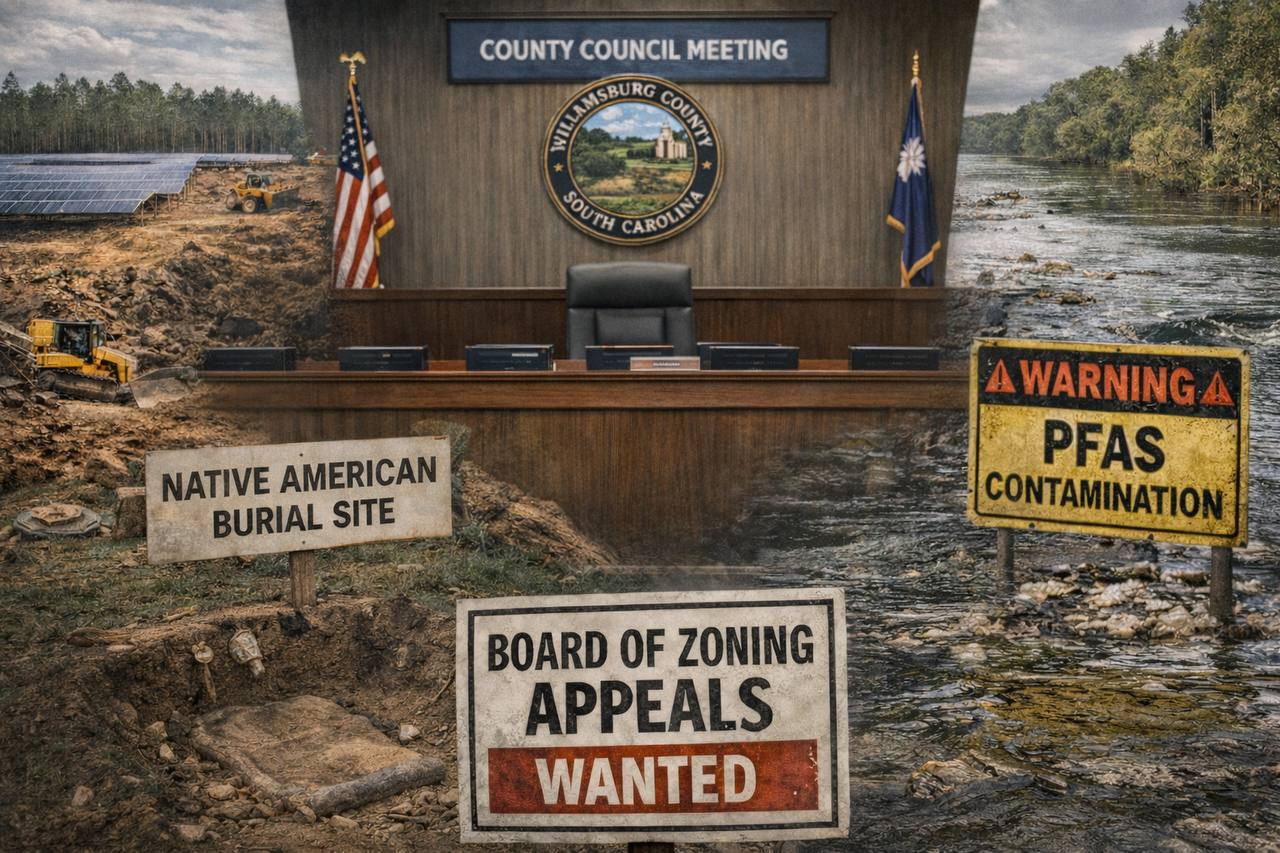
A recurring focus of their advocacy has been Williamsburg County’s apparent willingness to accommodate large corporate interests, particularly utility-scale solar projects and industrial expansions, often at the expense of residents, environmental integrity, and cultural preservation.
Thousands of acres have been deforested, natural habitats destroyed, and rural landscapes permanently altered. Equally alarming is the county’s repeated dismissal of community outcry regarding Native American burial sites and cultural artifacts located in development areas. These concerns have been raised publicly, documented, and ignored.
Dr. Lane and Dr. Bennett have asked a simple but powerful question:
Why are corporate timelines prioritized while community voices are sidelined?
Project Slipshot and the PRET Advanced Materials Expansion
Those concerns intensified with the proposal known as Project Splitshot, tied to a major expansion of PRET Advanced Materials, located in a shared industrial park between Williamsburg and Florence counties.
During public comment, Dr. Lane issued a clear challenge: If council members cannot answer basic questions in a public forum, they cannot lawfully or ethically vote on the project.
She then placed the following questions squarely on the public record:
• What is Project Splitshot?
• Is it owned, wholly or in part, by a foreign entity?
• Is the company established, and does it have a proven track record?
• Where is the exact location of the project?
• What portion, if any, lies within Williamsburg County?
• Have environmental impacts been fully considered, and what are the real, numeric costs and benefits to the county?
• Is there a Fee in Lieu of Taxes (FILOT) associated with this project, pending or grandfathered?
• Does the project align with the county’s Comprehensive Plan, including flood zones, wetlands, and cultural or historical protections?
• Will hazardous or industrial waste be produced, and how will adjacent landowners be notified?
• Where are the complete Brownfields EPA grant documents, and how can the public participate if no hearing is scheduled?
Her final point struck at the heart of the issue: transparency is meaningless if information is withheld until after decisions are made.
A Critical Environmental Connection
The urgency of these questions is underscored by a critical fact: PRET Advanced Materials is one of the companies named in the Georgetown County environmental lawsuit over PFAS contamination.
In that case, Georgetown County Water and Sewer District sued chemical manufacturers and industrial users, including PRET Advanced Materials, alleging that PFAS, or “forever chemicals,” discharged into waterways contaminated the Waccamaw River, the county’s drinking water source.
Testing revealed PFAS levels nearly three times the federal drinking water limit.
PFAS exposure has been linked to cancer, liver damage, immune system suppression, and developmental harm to infants and unborn children. Removing them from drinking water requires costly, sophisticated filtration systems, costs that often fall on taxpayers.
While Georgetown County chose accountability, filing suit and demanding compensation, Williamsburg County has shown little urgency regarding similar risks to the Black River, even as industries expand and freshwater resources continue to shrink.
Growth vs. Water: An Unequal Equation
As Dr. Lane and Dr. Bennett have repeatedly emphasized, industrial growth without environmental accountability is not economic development, it is deferred damage. While facilities grow larger and profits expand, clean freshwater supplies are diminished by PFAS, industrial runoff, and long-term contamination that will persist for generations.
The question is not whether Williamsburg County can grow, but whether it can grow responsibly.
Due Process Denied: The Missing Board of Zoning Appeals
Beyond environmental concerns, Dr. Lathonia Bennett has repeatedly sounded the alarm over a fundamental failure of governance: Williamsburg County does not have a functioning Board of Zoning Appeals (BZA).
Under South Carolina law, a BZA is essential. It is the legal body that allows residents to appeal zoning, permitting, and land-use decisions. Without it, citizens are effectively barred from challenging approvals that affect their property, health, and quality of life.
Dr. Bennett has been unequivocal:
“That denial is not accidental. It has allowed unchecked agendas to proceed without lawful challenge.”
Without a BZA, residents are denied due process, a constitutional protection that ensures government decisions can be reviewed, appealed, and corrected. In practical terms, this means projects can move forward with minimal oversight, while citizens are left without a legal avenue to object.
Rubber Stamp or Representation?
Dr. Lane challenged council members to imagine themselves in the place of residents, citizens limited to three minutes, sometimes forced to speak under pseudonyms, watching decisions unfold that will shape their county for decades.
Her message was clear: a vote without answers is not leadership; it is abdication.
Through persistence, preparation, and courage, Dr. Cheryl Lane and Dr. Lathonia Bennett have filled a void left by those elected to lead. They are not obstructionists. They are demanding what responsible government requires: transparency, accountability, environmental stewardship, and lawful due process.
As industries grow larger and decisions accelerate, one truth has become unavoidable in Williamsburg County: the people’s strongest advocates may no longer be seated on the dais, but standing at the podium.
