
By Palmetto State News Room Editorial Staff
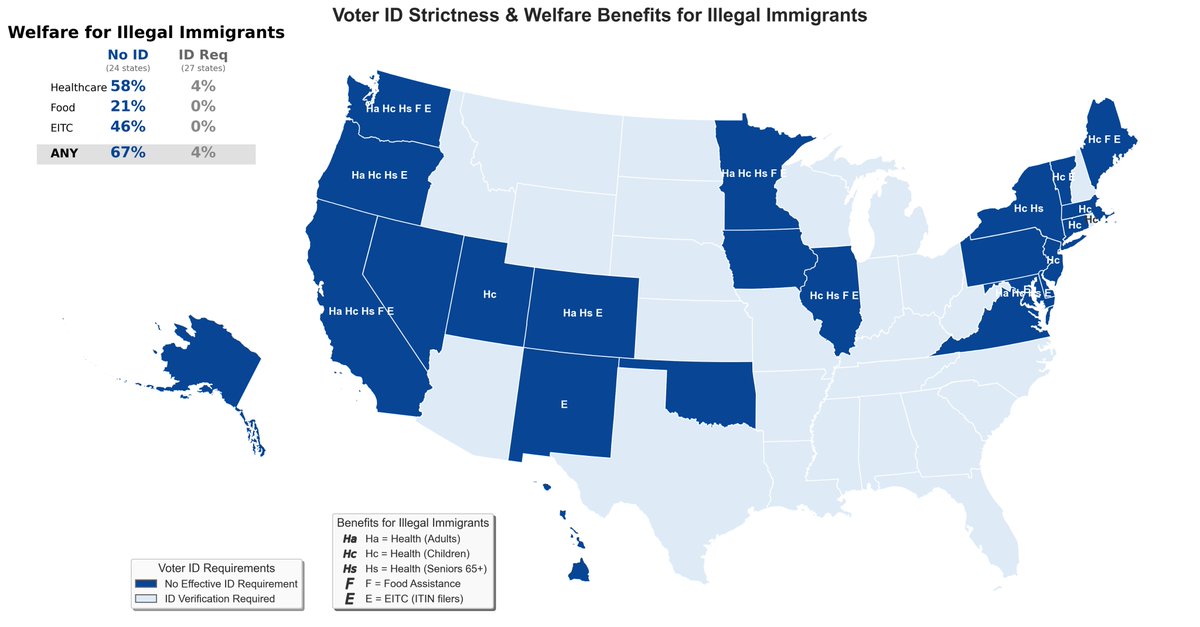
A map’s been making the rounds online. It lines up two things: how tough each state is on voter ID, and which ones hand out state-funded welfare benefits to illegal immigrants. That’s it.
It’s not pretending to show anyone’s secret motives or to read anyone’s mind. It just lays out the facts, side by side. And that’s what makes it interesting.
Of course, some politicians and media “fact-checkers” are already complaining. But the map doesn’t mislead about what it is.
It simply shows: here’s where voter ID is strict, here’s where it’s loose, and here’s which states offer benefits to people in the country illegally. You can agree or disagree with the policies, but you can’t say the map is hiding anything.
Americans deserve to see these facts put together, even if it makes some folks uncomfortable.
The map isn’t accusing anyone of crime. It doesn’t yell about fraud or try to spin the data.
It just says: these are the choices states are making. Some want strict ID to vote; some don’t. Some give public benefits only to citizens; others open up healthcare and tax breaks to illegal immigrants.
That’s not an exaggeration. That’s just what’s happening. If anyone’s upset by the trend, their real problem is with the policies, not the map.
People like to repeat that illegal immigrants are “barred from welfare,” but that’s not quite true, and it’s often used to dodge the real debate.
Federal law does block access to certain programs, but illegal immigrants don’t get shut out of everything. Emergency Medicaid is available everywhere. Public schools have to take all kids, no matter their status.
Programs like WIC and school meals are open to all. On top of that, some states spend their own taxpayers’ money to fund healthcare for illegal immigrants, and a few let people claim state Earned Income Tax Credits with just an ITIN, not a Social Security number.
These aren’t just theoretical benefits. They cost real money, and taxpayers are already struggling with higher prices and housing shortages.
Most families don’t care about the difference between federal and state dollars. To them, it’s all money out of their pockets.
Around the world, voter ID isn’t some controversial idea. It’s normal.
Most democracies require some kind of identification to register or to vote. The claim that voter ID is “undemocratic” doesn’t hold up if you look at other countries.
What stands out is how much pushback there is in the U.S. against having one set of rules, especially in states that also keep expanding benefits for illegal immigrants.
Americans are right to wonder why something so basic everywhere else is treated like a radical idea here.
Non-citizens aren’t supposed to vote. That’s the law.
But it still happens. There are documented cases, actual investigations, even convictions. Just because it’s hard to track doesn’t mean it’s pure fantasy.
When states lower the bar for voter verification, cut back on ID requirements, expand benefits to illegal immigrants, and ease up on border enforcement, it’s only natural to worry about the system’s weak spots.
No one’s saying millions of fake votes are pouring in. The point is, systems shape behavior and incentives. If you build in loopholes, people will use them.
This is really about trust.
Democracy isn’t just about rules on paper—it’s about whether regular people believe the system is fair and secure. If Americans keep seeing uneven election laws, billions in benefits going to non-citizens, and endless fights over basic ID checks, that trust starts to break down.
That’s dangerous, no matter how many times officials say, “Move along, nothing to see here.”
What the map really shows is what many Americans already suspect.
States that loosen election rules and open up benefits to illegal immigrants usually have the same philosophy about government. They put administrative power and dependency ahead of enforcement and citizenship.
That’s not a conspiracy theory. It’s just how some states choose to govern. And there’s nothing wrong with questioning it.
South Carolina shouldn’t go down that road.
We can show compassion without being reckless. We can welcome legal immigrants while still respecting the law.
We can say that voting is for citizens, that ID protects that right, that public benefits should go to the people paying for them, and that borders and elections matter.
The map didn’t invent this debate—it just brought it into the open.
And people are watching.
