
Williamsburg County Council is gearing up for some big decisions, and once again, taxpayers are mostly stuck watching from the sidelines—sometimes literally, sometimes just in spirit.
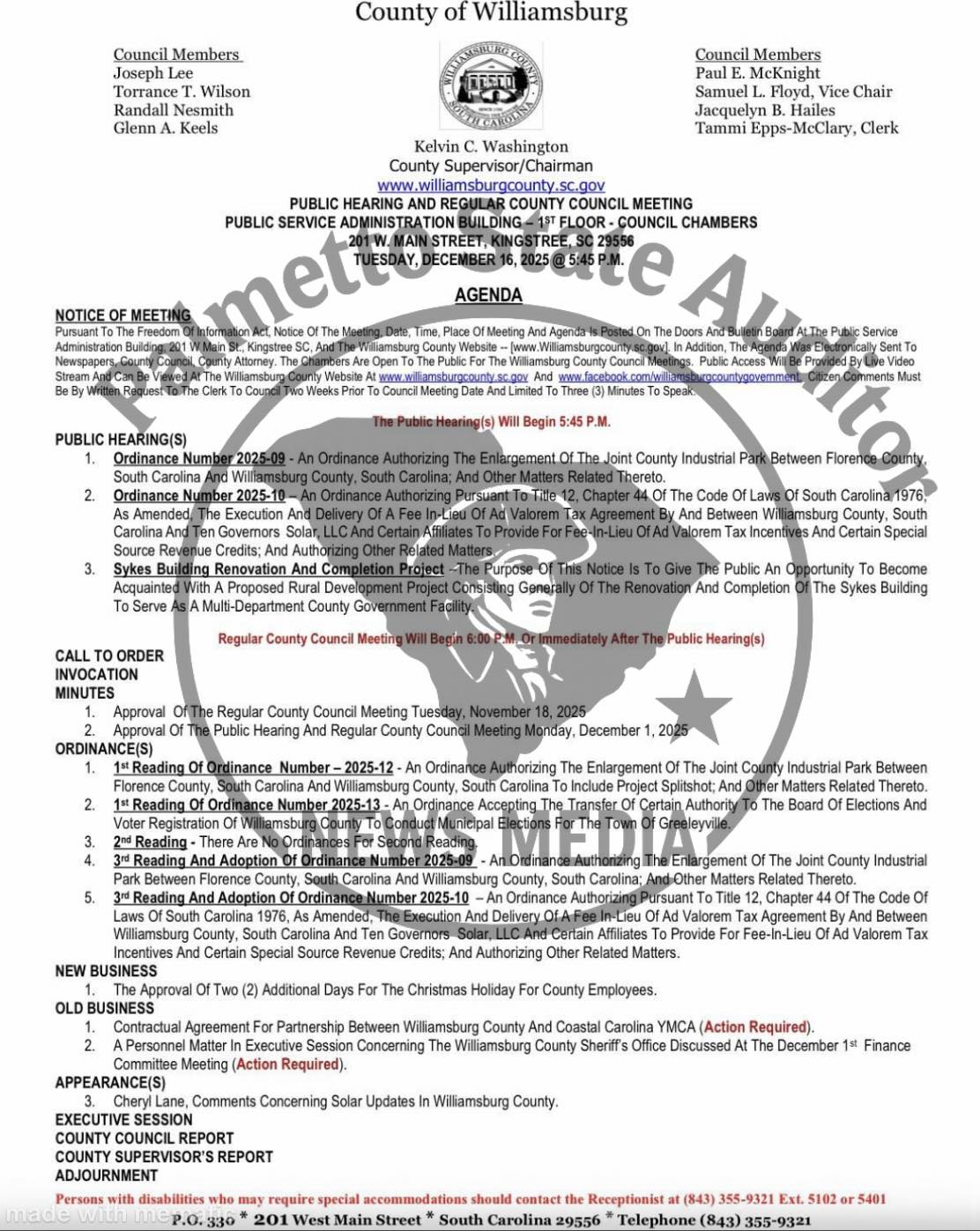
If you dig into the fine print on the meeting notice, there’s a rule that keeps tripping people up: if you want to speak at a public hearing, you have to submit a written request two weeks ahead of time. Then, you get three minutes. That’s it. For a lot of folks, that just doesn’t add up. How’s a public hearing supposed to be “public” when you have to sign up before you even know what’s really on the table?
This hits especially hard right now, because the agenda is packed. One of the biggest items is Ordinance 2025-10, which would let the county enter a Fee-In-Lieu of Ad Valorem Tax (FILOT) Agreement with Ten Governors Solar, LLC and its affiliates. It offers tax breaks and special revenue credits—tools designed to attract development. But these same tools can shift the tax load off corporations and onto regular people.
If this feels familiar, that’s because it is. The county has already handed out similar incentives, first for the Kingstree West solar project in Greeleyville, then for the even bigger Kingstree East project near Nesmith and Hemingway. Each time, leaders said the incentives were necessary to lure in investment. But lots of critics say solar companies already like Williamsburg County because they know they’ll get these deals.
So the big question is: If these incentives are the main draw, why does County Council keep making the offers sweeter, and why does it all happen without a real, open debate?
Here’s the other problem: By the time most people figure out the details of these FILOT agreements, it’s already too late to comment. Sure, the meetings are livestreamed and technically open to the public. But if you have to request your three minutes of speaking time weeks in advance, how are you supposed to weigh in on complicated stuff like tax policy, lost revenue, or changes to land use?
And let’s talk about the bigger picture. No one’s really discussing what these deals actually cost taxpayers in the long run. When big projects get tax breaks, there’s less money for schools, roads, and basic services—unless that lost revenue comes from somewhere else. To make things even more interesting, the same meeting includes the Sykes Building Renovation and Completion Project, which taxpayers will help pay for. So residents are being asked to fund public projects while corporate tax deals get a quick pass.
Supporters say these incentives are standard practice and the county is just following the usual routine. But critics aren’t buying it. Just because you’ve always done it this way doesn’t mean it’s transparent, and it definitely doesn’t mean the public is getting a fair shot to participate.
As County Council gets ready to lock in Ordinance 2025-10, regular people are left wondering:
– Why do citizens have to jump through hoops just to speak at a public hearing?
– Why do these massive tax incentive deals keep sliding through with barely any public discussion?
– And why does the county keep offering more and more to solar developers, when those perks are the main reason they’re here in the first place?
Until those questions get some honest answers, it’s hard not to feel like public hearings are just for show, and the real decisions happen somewhere else. And let’s not ignore the recent video from the County supervisor, where he tells people to call their council members and push for a Yes vote on these very issues. That’s crossing a line—and everyone knows it.

Comments (1)