
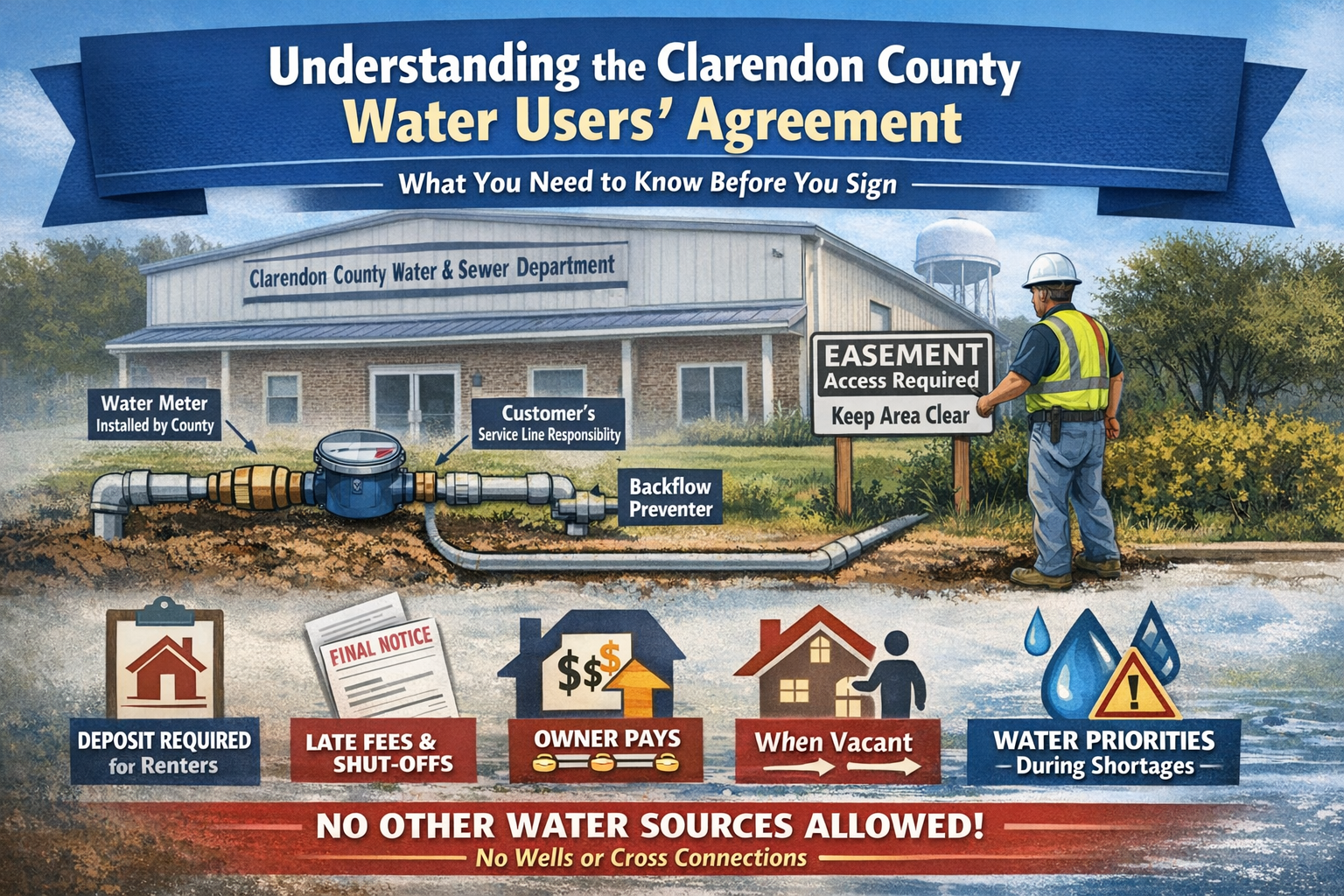
What the Clarendon County Water & Sewer User Agreement Really Means for Customers
By PSA Newsroom Staff
For many Clarendon County residents, turning on the tap is a daily routine that doesn’t require much thought, until a bill arrives, service is interrupted, or a document called the Water Users’ Agreement lands in front of them. That agreement, required for anyone receiving water service from the Clarendon County Water & Sewer Department (CCWS), lays out more than just access to water. It defines rights, responsibilities, costs, and consequences that directly affect households, renters, landlords, and property owners across the county.
Here’s what the agreement actually means, in plain language.
Access to Water Comes With Conditions
By signing the agreement, a customer formally requests water service from CCWS for a specific property, identified by a tax map number and legal address. The county agrees to provide water as long as the system has sufficient capacity and subject to CCWS rules and regulations — including any changes made in the future.
In other words, water service is not unlimited or unconditional. Availability depends on the system’s ability to deliver it.
Who Pays for What? Understanding Installation Responsibilities
Clarendon County installs and pays for:
-
- The water meter
-
- The cutoff valve
-
- The service line from the main to the property line
Once the water reaches the property line, responsibility shifts to the customer.
Customers must pay for and maintain:
-
- The service line from the meter to the home or business
-
- Any required backflow prevention device
-
- Repairs for leaks or damage beyond the meter
The county retains exclusive control over the meter and cutoff valve, meaning customers cannot tamper with or adjust them.
Easements: A Permanent Right of Access
The agreement grants CCWS a perpetual easement on the property. This allows the county ongoing access to:
-
- Install and maintain water lines
-
- Inspect and repair infrastructure
-
- Enter the property as needed to service equipment
Customers must also keep the area around meters and water lines clear of obstructions. If something blocks access, fencing, debris, landscaping, etc., the property owner must remove it when asked.
Rules, Rates, and Penalties Can Change
Customers agree to follow all current and future CCWS rules and regulations, including rate changes and penalty structures. That means:
-
- Water rates are set by CCWS, not by individual agreement
-
- Penalties for noncompliance apply automatically
-
- Changes adopted later still apply to existing customers
This clause gives CCWS broad authority and places the burden on customers to stay informed.
Landlords and Vacant Properties
Property owners should pay close attention to one key provision:
-
- When a rental property is vacant or a tenant moves out, the account automatically reverts to the property owner
-
- The owner is responsible for paying the minimum bill even when no one is living in the unit
This ensures accounts never go “unowned,” but it can surprise landlords who assume utilities stop billing when a tenant leaves.
Deposits for Renters
If the customer is not the property owner, CCWS requires a $150 deposit.
That deposit:
-
- Is applied to any unpaid balance if service is terminated
-
- Is refunded by check if the account is paid in full
-
- Is held until service ends, even if the customer moves
Water Shortages: Who Gets Priority
During water shortages, CCWS has final authority to:
-
- Allocate water among customers
-
- Set usage schedules
-
- Restrict non-essential use
Domestic household needs must be met first. Water for livestock or gardening comes after, and may be limited or suspended during shortages.
No Outside Water Connections Allowed
Customers may not connect:
-
- Wells
-
- Secondary water systems
-
- Any alternate water source
All cross-connections must be removed before switching to CCWS service. This rule protects the public water supply from contamination.
Charges Begin Even If You Don’t Hook Up
One of the most overlooked clauses states that billing begins the day water is made available, not the day a customer connects or starts using it.
Failing to connect and start using water without justification can trigger a $750 liquidated damages fee, which the agreement defines as compensation for losses that are difficult to calculate.
Late Payments Carry Immediate Consequences
If a customer doesn’t pay on time:
-
- A 10% penalty is added after the due date
-
- Water service can be shut off after the 10th day of the following month
-
- A reconnection fee is charged to restore service
These penalties apply automatically and are not discretionary.
Why This Agreement Matters
The Water Users’ Agreement is more than paperwork, it is a binding contract that governs how water is delivered, paid for, and controlled in Clarendon County. For customers, renters, and property owners alike, understanding its terms can help avoid unexpected costs, service interruptions, and disputes.
As water infrastructure costs rise statewide, agreements like this one shape how local governments balance public service with financial sustainability —and how much responsibility ultimately falls on the people who turn on the tap.
PSA Newsroom will continue reviewing local utility policies and agreements to help residents understand how public services impact their daily lives.
