
By PSA Newsroom Staff
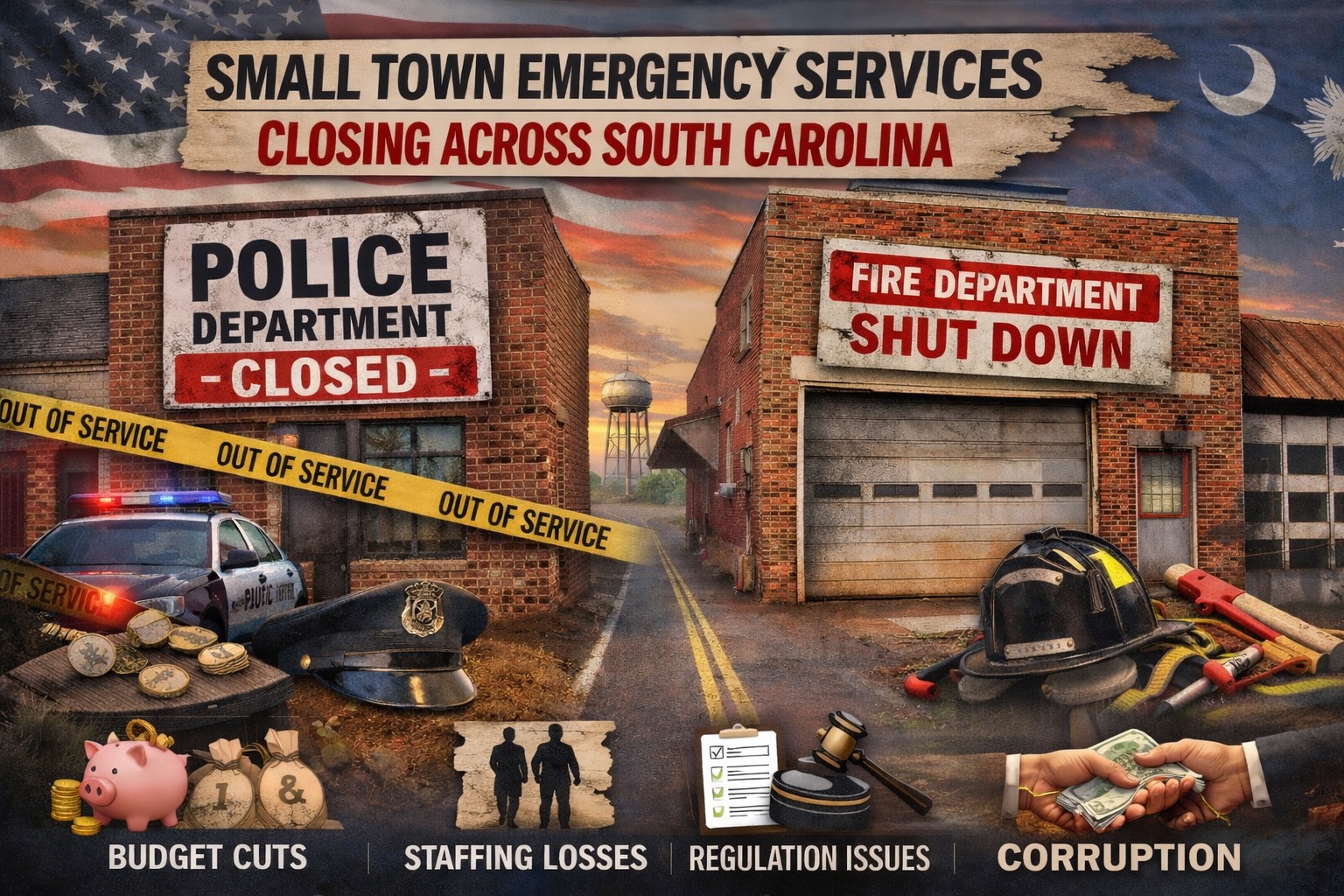
Across South Carolina, public safety in small towns is under strain: local police and fire services are shrinking, collapsing, or disappearing entirely. Since 2023, a string of municipalities has lost their police departments — and in several communities, fire and rescue services are also disrupted. Residents are increasingly dependent on county agencies and neighboring districts for emergency protection.
Verified Police Department Losses and Disruptions (2023–2025)
Summerton (Clarendon County)
In early 2025, Summerton’s police force effectively collapsed after multiple officers resigned and the police chief announced his retirement. The Clarendon County Sheriff’s Office has stepped in to provide patrol coverage. The resignations appear tied to broader staffing and recruitment challenges typical of very small departments; there are no credible reports of corruption allegations tied to the resignations themselves at this time. Town officials say the chief’s retirement was a personal decision separate from the others’ departures. *Note: Currently the Town’s official letterhead lists the “Police Chief: Vacant.”
Latta (Dillon County)
Mid‑2025, the South Carolina Criminal Justice Academy suspended the certifications of Latta’s police chief and officers due to noncompliance with state training and standards, halting routine local policing until those issues were resolved. There are no verified reports alleging corruption in this case — the suspension was administrative, linked to regulatory compliance.
McColl (Marlboro County)
In late 2024, McColl’s entire police department resigned. Officers, including the chief, cited a hostile work environment, internal disputes, and budget cuts — not proven corruption. Local news outlets reported morale and management issues as primary drivers.
Belton (Anderson County)
Belton dissolved its police department in 2024, contracting with the Anderson County Sheriff’s Office as a cost‑saving measure. There are no substantiated corruption allegations tied to this policy decision.
Swansea (Lexington County)
In late 2025, Swansea’s police chief and sole other officer initially resigned over financial constraints; the chief later reversed his resignation but the department remains extremely under‑resourced. Local business leaders publicly questioned the town’s financial management, but there is no verified evidence of official corruption in the resignations or finances beyond budget shortfalls.
Fire & Rescue Services: Verified Issues and Misconduct
Wagener (Aiken County)
Wagener’s fire services have faced repeated operational crises, and official misconduct allegations have been documented. In August 2025, two former fire officials were arrested on charges including breach of trust and misconduct in office stemming from a South Carolina Law Enforcement Division (SLED) investigation into financial irregularities.
Separately, prior inquiries found questionable spending in the department’s finances, including unexplained transfers of funds meant for fire protection — prompting scrutiny by SLED, the IRS, and the FBI. These past controversies show a pattern of financial mismanagement that rose to the level of criminal charges against individuals.
Sandy Run (Calhoun County)
The Sandy Run Volunteer Fire Department closed in mid‑2025 amid disputes over consolidation into a county fire district. There is no current evidence of corruption in this dispute; it centers on organizational and contractual disagreements.
Fire District Consolidations
In places like Florence County, consolidation of multiple independent fire districts into a unified county system reflects an administrative response to financial and staffing challenges — not corruption.
Common Drivers Behind Public Safety Service Losses
While each town’s situation is distinct, several verified factors are central:
-
- Budget Limits and Fiscal Strain. Small tax bases and rising costs for personnel, training, equipment, and insurance make sustaining traditional departments difficult.
-
- Recruitment & Retention Challenges. Small rosters are vulnerable: when a few officers or volunteers leave, coverage can collapse rapidly.
-
- Administrative/Regulatory Burdens. Compliance and certification requirements can hinder small departments when administrative resources are thin (as seen in Latta).
-
- Shift to Regional or County Services. As local agencies falter, sheriff’s offices and larger districts step in — but often at the expense of local responsiveness.
What This Means for Residents
For towns like Summerton, Latta, McColl, Swansea, and Wagener, the loss or weakening of local emergency services is more than a policy story — it’s a daily public safety challenge. Residents increasingly depend on distant responders rather than neighbors who once patrolled their streets or answered fire calls.
In some cases, investigations and criminal charges against former officials (e.g., in Wagener) show that mismanagement and corruption allegations are real and substantiated, not unverified rumors. In others, problems stem from funding and staffing pressures with no credible evidence of corrupt conduct.
