
By PSA Newsroom Staff
When Charleston attorney Mullins McLeod announced his bid for Governor of South Carolina in 2026, he called for honesty, accountability, and service in state government, promising to challenge the status quo and “fight for everyday people.” His campaign has leaned into themes of standing up to entrenched interests and demanding transparency from the political establishment — messages he’s repeated in speeches and social media posts since announcing his candidacy.
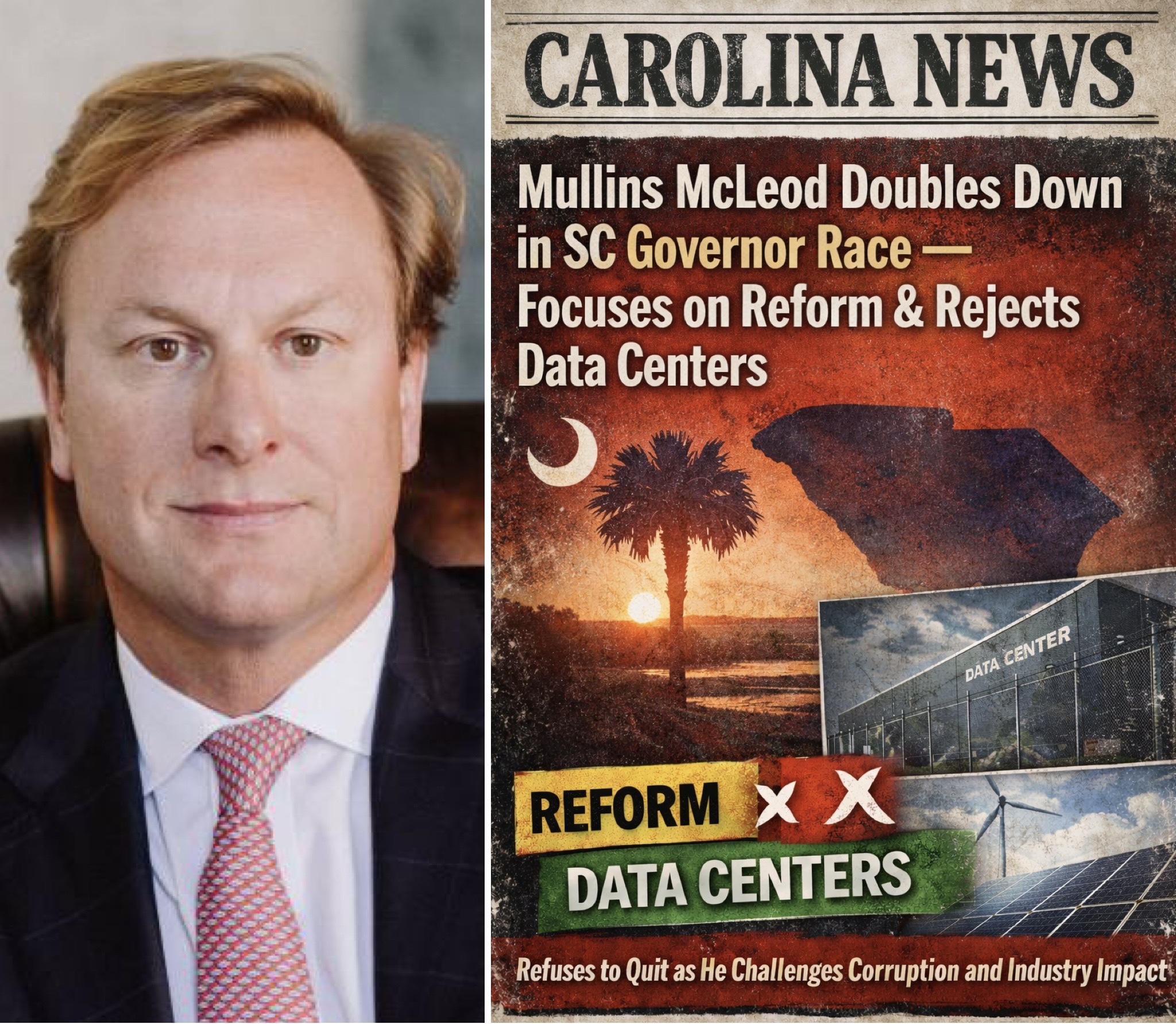
Since refusing calls from party leaders to exit the race, McLeod has doubled down on his intent to stay the course, telling supporters in online videos that he is weathering opposition because he represents a needed voice for change within his own party and beyond. He has described the political pressure to withdraw as proof of his outsider status, arguing that it reveals a system resistant to accountability and new voices.
McLeod’s Views on Alternative Energy and Data Centers
In addition to messaging about government reform, McLeod has been outspoken about how South Carolina develops energy infrastructure and manages proposed data center projects. Those sectors have become increasingly important as both technology firms and state leaders look for ways to grow the economy and expand energy production.
McLeod has taken a critical stance on large data centers proposed for rural parts of the state, especially a massive project near Walterboro in Colleton County. In a letter to local officials and in social media remarks he described such facilities as “death stars,” a pointed metaphor suggesting these sites prioritize profit over people’s quality of life and environmental stewardship. In that messaging, McLeod argued data centers could drive up the cost of living, strain natural resources, and disrupt rural ways of life without delivering meaningful long‑term benefits to local residents and families.
This stance puts McLeod in alignment with residents and some local politicians who have also voiced concerns about the scale of data centers proposed for South Carolina’s Lowcountry, where rapid growth of power‑hungry facilities has spurred debates over electric grid impacts, water usage, and environmental protection, especially in ecologically sensitive areas like the ACE Basin.
On energy more broadly, McLeod has also emphasized the need to think critically about how South Carolina meets its future power needs, especially amid increasing demand from both population growth and technology infrastructure. While he has not outlined a detailed statewide energy plan, his public criticism of large data centers reflects a broader concern about how energy usage and utility costs are managed in the state — including whether residents face higher bills to subsidize industrial growth and whether renewable or alternative energy sources are prioritized alongside traditional development. McLeod’s rhetoric has resonated with voters in areas wary of rapid industrialization and rising energy costs, and it aligns with a larger statewide conversation about how best to balance economic development with environmental protection and affordability.
Messaging Beyond Headlines
Since reaffirming his candidacy, McLeod’s campaign content has remained focused on his core message of servant leadership and accountability, with discussions on energy and data centers providing a policy backdrop to his broader vision of government that listens to everyday South Carolinians. He emphasizes independence, both financial and political, as essential to resisting the influence of powerful interests, whether in Columbia or in sectors like technology and energy.
Supporters view his refusal to step aside as a sign of resilience; critics argue it may reflect a lack of strategic focus on issues that could yield broader appeal in a statewide contest. What voters hear from McLeod on policy, not just controversy, will be a key factor as the 2026 campaign develops.
