
By PSA Newsroom Staff
Clarendon County, S.C. — National School Choice Week, observed in South Carolina from Jan. 25 through Jan. 31, shines a light on the growing number of K–12 education options available to families. Traditional public schools, charter and magnet programs, private schools, online learning, and homeschooling are all part of that landscape.
The week is not about declaring winners or losers. It is about helping families understand their choices — and about asking hard questions when those choices grow faster than enrollment in local schools.
For Clarendon County School District, those questions are becoming harder to avoid.
Fewer Students, Bigger Decisions
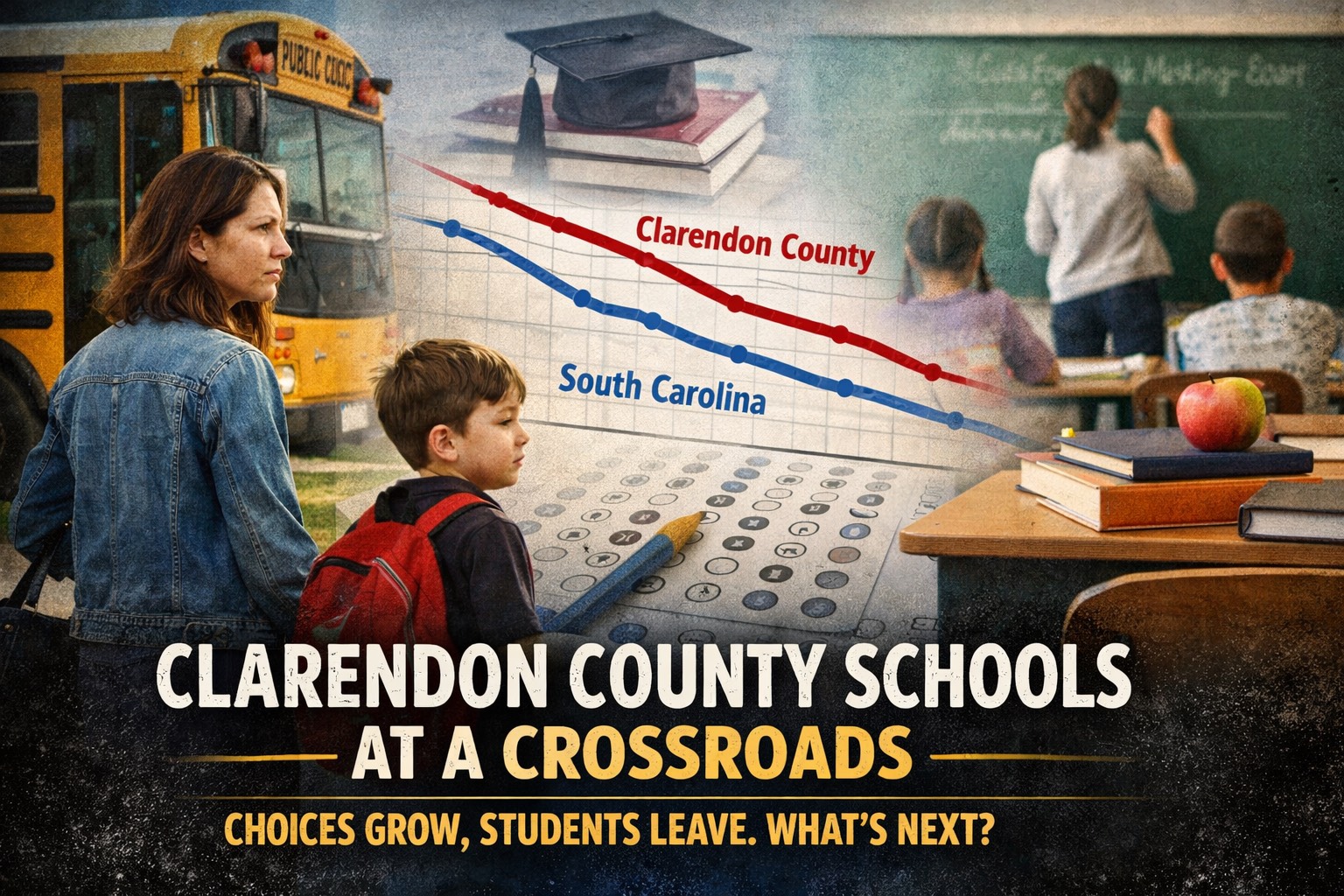
Clarendon County schools currently serve 3,990 students, down from 4,632 in 2019. That is a loss of roughly 14 percent in just six years. During the same period, South Carolina’s overall public school enrollment declined by about 3 to 4 percent, according to state data.
In other words, Clarendon’s enrollment is shrinking faster than the state as a whole.
Enrollment numbers are not just statistics. They represent families making decisions — some driven by opportunity, others by frustration, and many by simple economics. While some parents actively choose alternatives such as private schools, charter schools, or homeschooling, others remain because they cannot afford to leave.
That reality makes academic improvement more than a talking point. It makes it urgent.
Spending More, Standing Still
Clarendon County spends an average of $16,738 per student each year, slightly above the statewide average. For a rural district, higher per-student costs are not unusual. Transportation, staffing, and facilities all cost more when students are spread out.
But higher spending does not automatically translate into better outcomes — and families notice when results feel flat.
State report cards show most Clarendon schools rated “Average.” The district’s 92.8 percent graduation rate is slightly above the state average, but proficiency levels in core subjects such as English and math remain at or near statewide norms.
In a school choice environment, being average can be a problem. Families with options tend to look for schools that stand out, not schools that simply keep pace.
How Clarendon Compares to Similar Districts
Compared with other rural districts, Clarendon sits in the middle.
Some peer districts with similar demographics have managed to slow enrollment losses by posting stronger academic growth. Others with weaker performance have seen sharper declines. Clarendon is neither the worst nor the best — but that middle ground has not been enough to stop families from leaving.
Education analysts often point to academic growth, not just test scores, as the key factor in retaining students. Districts that show clear progress tend to hold on to families even when alternatives exist.
Teachers Feel the Pressure Too
Enrollment and academics are only part of the picture. Teacher retention plays a critical role in school stability.
Clarendon County reports retaining about 82 percent of its certified teachers, an improvement over previous years. Statewide, teacher vacancies have declined, but many educators still cite burnout, limited classroom flexibility, and heavy testing demands as reasons colleagues leave the profession.
Schools that retain teachers tend to build stronger relationships with students and families. Schools that do not often struggle to gain trust — and trust matters when parents are deciding where to send their children.
What the Data Says — and What Families Feel
The data says:
-
- Graduation rates are steady
-
- Per-student spending is above average
-
- Schools are mostly rated “Average”
Families often feel:
-
- Academic results are not clearly improving
-
- Other options appear more responsive
-
- Staying feels safer than better
That gap between data and perception is where enrollment decisions are made.
Choice, Accountability, and What Comes Next
Supporters of school choice argue that expanding options creates accountability, pushing districts to improve performance and transparency. Critics worry that choice programs can drain resources from traditional public schools if growth is not managed carefully.
What is harder to dispute is this: families now have more information and more options than ever before.
The South Carolina Department of Education makes enrollment data, school report cards, staffing information, and school choice details publicly available. Parents are using that information — and acting on it.
Why Transparency and Accountability Matter Most
At its core, the school choice debate is not just about alternatives. It is about trust.
When families feel shut out of honest conversations about academic performance, spending priorities, or
improvement plans, confidence erodes. A lack of transparency does not keep students enrolled; it pushes families to look elsewhere. Likewise, accountability is not an attack on public education — it is a safeguard for it.
Districts that openly share data, acknowledge weaknesses, and clearly explain how resources are being used are better positioned to earn public trust, even during periods of change. Those that do not risk appearing defensive or disconnected from the realities families face.
For Clarendon County, the path forward is less about resisting choice and more about embracing accountability.
Families are asking reasonable questions: Are outcomes improving? Are teachers supported? Are decisions being made with students at the center?
If those questions go unanswered, the choices families make will answer them instead.
Bottom Line
National School Choice Week is a reminder that education decisions are no longer theoretical. They are personal, practical, and increasingly data-driven.
Clarendon County School District is not failing. But it is under pressure. Without visible academic growth, strong teacher support, and renewed trust with families, enrollment declines are likely to continue.
In today’s education landscape, standing still is not neutral. It is a choice — and families are making theirs.
