
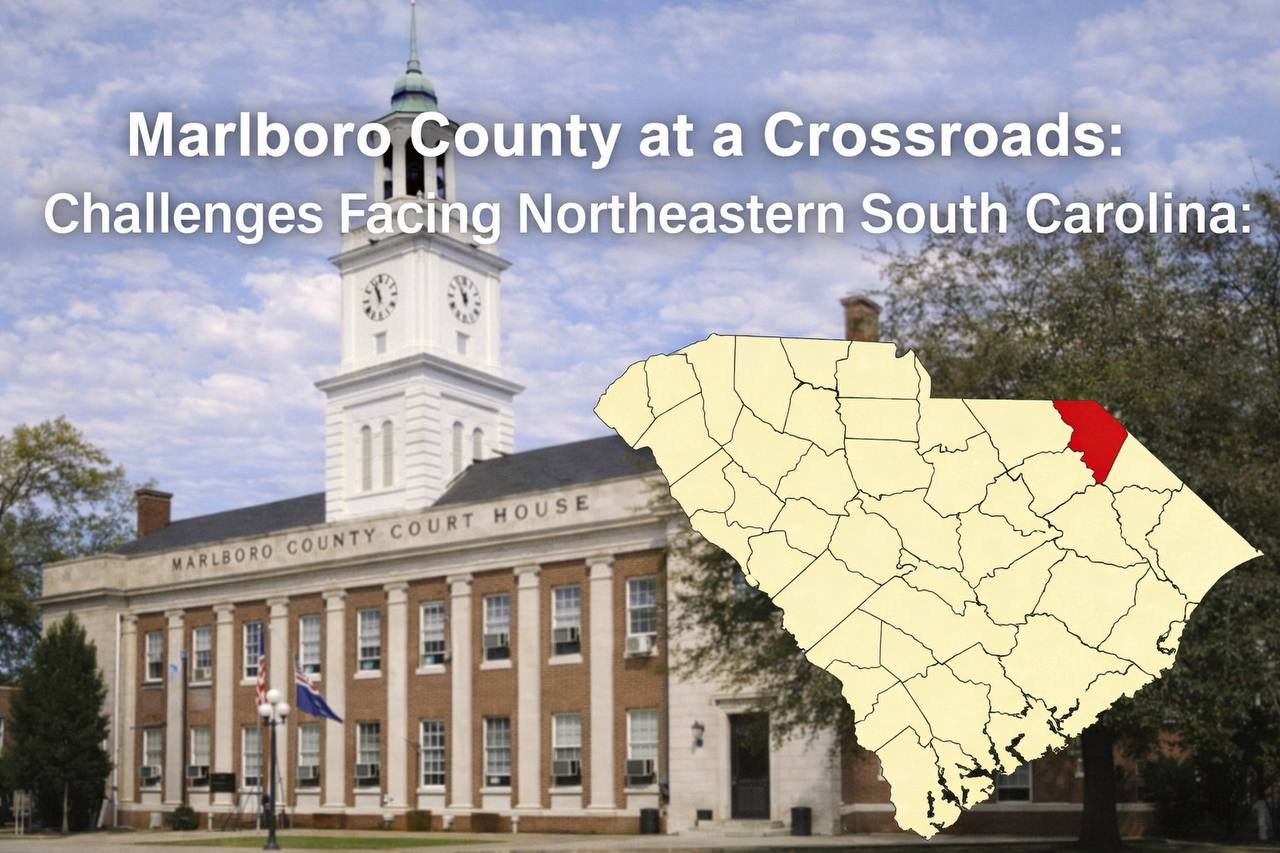
A County at a Crossroads: Marlboro County’s Struggles and the Voices Calling for Change
By PSA Newsroom Staff
Marlboro County, a rural community of roughly 26,000 residents in northeastern South Carolina, is facing a convergence of long-standing problems that have reached a breaking point. Economic hardship, political discord, and a school district under state financial control have left many residents asking the same question: How did it get this bad and what comes next?
Behind the statistics and state interventions are families, educators, and taxpayers who say they’ve been sounding alarms for years.
Who Represents Marlboro County
At the federal level, Marlboro County is part of South Carolina’s 7th Congressional District, represented in the U.S. House by Republican Russell Fry. The county’s U.S. Senators are Lindsey Graham and Tim Scott, both Republicans. At the state level, the county’s legislative delegation includes:
State Senator Kent M. Williams (D), representing Senate District 30, which includes Marlboro County among others. State Senator J.D. Chaplin (R), representing Senate District 29, which also covers Marlboro County. State Representative Jason S. Luck (D) in House District 54, representing most of Marlboro County. (Former Representative Patricia Moore “Pat” Henegan served District 54 for a decade before retiring in 2024.)
These officials are the lawmakers residents go to when they have concerns about schools, infrastructure, economic development, and state budgeting, all issues Marlboro County faces on multiple fronts.
Economic Hardship Felt at the Kitchen Table
Marlboro County remains one of South Carolina’s poorest counties, with high child poverty and limited job opportunities. Residents say the lack of economic growth touches everything.
“It feels like we’re always trying to do more with less,” said a longtime resident of Bennettsville. “When people struggle to pay bills, it eventually shows up in schools, in government, in everything.”
Another neighbor added:
“Our kids graduate and don’t come back. There’s nothing here for them. That’s not just a school problem, that’s a county problem.”
A School District in Crisis and Eroding Trust
The Marlboro County School District (MCSD) has become the most visible symbol of the county’s instability. Years of financial mismanagement culminated in a roughly $6.9 million deficit, repeated budget delays, and ultimately a state-imposed financial takeover for the 2025–26 school year.
Parents say the crisis has shaken their confidence in district leadership.
“Every year it was a new emergency,” said a parent with children in the district. “One year it’s budget problems, then it’s talk of closing schools, then the state has to step in. At some point, you start asking who’s actually in charge.”
Teachers describe low morale and uncertainty.
“We’re worried about our jobs, but we’re more worried about the kids,” said one educator. “When leadership is unstable, the classroom feels it.”
Superintendent Leadership Under Scrutiny
A central figure in recent educational leadership has been Superintendent Dr. Helena Tillar, who led the district during much of the financial turmoil and state intervention. While state education officials emphasized collaboration with Tillar during the takeover, many residents questioned how the district reached such a precarious financial position under her leadership.
“Nobody expects one person to fix everything,” said a concerned resident. “But when the same problems keep happening year after year, people want accountability.”
In late 2025, the board appointed an interim superintendent from outside the district to guide recovery efforts, a change some locals saw as long overdue.
“That should have happened before the state had to come in,” one parent said. “It feels like we lost local control because leadership didn’t act soon enough.”
School Closures, Safety, and Community Identity
Proposals to close or consolidate schools struck a nerve, particularly in small towns like Clio, where schools are deeply tied to community life.
“When you close a school, you’re not just closing a building,” said a longtime resident. “You’re closing the heart of the town.”
Concerns about school safety incidents have further unsettled families trying to balance hope and worry for their children’s futures.
Local Government Discord Adds to Distrust
Beyond education, residents point to lawsuits, public disputes, and tension within county government as signs of deeper dysfunction.
“It’s hard to trust leadership when officials are suing each other or fighting in public,” said one resident. “We need cooperation, not constant conflict.”
County leaders acknowledge limited resources, but residents argue transparency and long-term planning are just as critical as funding.
A Common Thread: Accountability and Communication
Across conversations and public comments, a unifying theme emerges: residents don’t just want more money, they want clear leadership, honest communication, and accountability.
“We love this county,” one resident said. “People here are resilient. But resilience shouldn’t mean accepting dysfunction.”
Looking Forward
The involvement of the state in managing the school district’s finances and the presence of multiple levels of government, from local councils to state legislators like Senators Kent Williams and J.D. Chaplin and Representative Jason S. Luck, up to Congressman Russell Fry and Senators Lindsey Graham and Tim Scott, offers both challenge and opportunity. Their decisions will influence how Marlboro County rebuilds trust, stabilizes its institutions, and creates a future where young people want to stay and thrive.
For Marlboro County, the path forward will require more than intervention. It will require trust, rebuilt one decision, one classroom, and one community at a time.
